
Announcing our next ADHD Education Group!
A supportive 4-session online workshop to help you understand your ADHD brain and build practical strategies for a more balanced, fulfilling life.
Group 1 • Starts Oct 26, 2026
Oct 26 • Nov 2 • Nov 9 • Nov 16
Live Happy ADHD Coaching
Welcome.
Are you ready for a change but keep hitting roadblocks?
I can help you move from survival mode to thriving and reconnecting to the joy of life. I help my clients stay on track, create calm, and bring out the best in themselves. I invite you to learn how to enhance the way your unique ADHD brain works, instead of working against it.
Meet your Coach

I used to struggle with exactly the same thing.
Dorsey McFadden currently lives in Richmond with her husband and pets. She earned a double BA degree from the University of North Carolina at Chapel Hill in Political Science & Communications and International Security Studies & Rhetoric.
In her previous life, Dorsey worked in digital marketing for over 20 years. Now she’s building a career as an ADHD coach, educator, and advocate.
She also cofounded FlexYourADHD.com as a platform with a significant community of adults eager to learn about their ADHD.
As the founder and coach of Live Happy ADHD Coaching, Dorsey is passionate about coaching adults living with ADHD and parents of children with ADHD to help them live happy and healthy lives.
Together, she works with her clients to develop techniques and approaches to better understand how to support themselves and their children.
Dorsey aims to empower those with ADHD to work with their unique brain, not against it.
Meet your Coach
I used to struggle with exactly the same thing.
Dorsey McFadden knows ADHD from the inside. Diagnosed at age 7, she spent years learning — often the hard way — what works for her brain and what doesn't. That lived experience is the heart of her coaching: she's been where her clients are, and she knows that ADHD isn't a flaw to fix but a different way of operating that deserves understanding.
Since 2021, Dorsey has been helping people stop fighting their ADHD and start working with it. She trained through the ADD Coach Academy (ADDCA) and holds the AACC, PCAC, and ACC credentials from ADDCA and the Professional Association of ADHD Coaches (PAAC).
As the founder of Live Happy ADHD Coaching and FlexYourADHD.com, Dorsey works with adults with ADHD to build lives that actually fit the way their brains work. Together, she and her clients create personalized strategies that lean into ADHD strengths — with a focus on self-understanding, empowerment, and support systems that hold up in real life.
Before coaching, Dorsey spent 20+ years in digital marketing, and she brings that strategic, big-picture thinking into every session. She's also the founder of Coaches Flow Suite, an all-in-one business platform built specifically for ADHD coaches — because the people doing this work deserve tools designed for the way their brains work, too.
Her mission is simple: help people stop fighting against their ADHD and start thriving with it.
While there's no magic solution in life, the supportive, practical, concrete, and collaborative process of coaching can help to bridge the gap between where you are right now and where you want to be.
Do any of these sound familiar?

difficulty with planning and prioritizing
feeling unfulfilled and unsuccessful
impaired communication or social skills
trouble getting started/lack of initiative
difficulty maintaining focus
poor self-care (exercising, getting to bed, etc.)
difficulty explaining their ADHD to others
getting easily distracted and overwhelmed
challenges with working memory
poor time and energy management
lack of organizational skills
trouble harnessing motivation and interest
impulsivity/lack of inhibition
procrastination (sometimes extreme and high stakes)
poor communication skills
difficulty with planning and prioritizing
feeling unfulfilled and unsuccessful
impaired communication or social skills
trouble getting started/lack of initiative
difficulty maintaining focus
poor self-care (exercising, getting to bed, etc.)
difficulty explaining their ADHD to others
getting easily distracted and overwhelmed
challenges with working memory
poor time and energy management
lack of organizational skills
trouble harnessing motivation and interest
impulsivity/lack of inhibition
procrastination (sometimes extreme and high stakes)
poor communication skills
Testimonials
What Does Success Look Like?

That depends on the client.
For some it will look like completion of a project while, for others, it may be development of self compassion and self
awareness which enriches all areas of their life.
What Is Coaching?


Coaching is the facilitation of growth and change. A coaching partnership helps close the gap between who you are, what's important to you, and what you're doing. so that you can lead a more satisfying and effective life. Coaches support our client's understanding of their ADHD brain and its related challenges. As well as how it impacts your personal and professional life so that you can utilize practical, realistic strategies to shift from chaos to calm.
What Does Success Look Like?
That depends on the client.
For some it will look like completion of a project while, for others, it may be development of self compassion and self
awareness which enriches all areas of their life.
What Is Coaching?
Coaching is the facilitation of growth and change. A coaching partnership helps close the gap between who you are, what's important to you, and what you're doing. so that you can lead a more satisfying and effective life. Coaches support our client's understanding of their ADHD brain and its related challenges. As well as how it impacts your personal and professional life so that you can utilize practical, realistic strategies to shift from chaos to calm.
More Topics to explore
Something for every reader
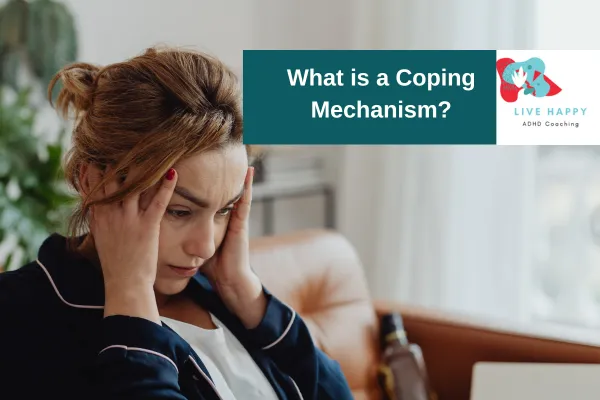
What is a Coping Mechanism?
The definition of Coping Mechanism is:
(noun) (Psychology) an adaptation to environmental stress that is based on conscious or unconscious choice and that enhances control over behavior or gives psychological comfort.Compare defense mechanism (def. 2).
Coping mechanisms are the strategies or skills people use to manage a problem. For people with ADHD these coping mechanisms help us manage life better.
When you have ADHD, you’ll need to develop coping mechanisms. In my mind it’s simply another way of saying “trick”. In other words, we can trick ourselves into building good habits.
Think of coping mechanisms as the tricks we use to get around our executive functioning deficiencies.
Understanding how ADHD manifests in yourself is key to successfully implementing coping mechanisms.
You may intentionally develop these or naturally adopt them.
My coping mechanism for the hellish time I have with medication management is to use several pill boxes.Here are examples of a few for me:
I put my keys in the same place every time I come in the door (otherwise they’ll end up someplace strange).
I schedule reminders throughout the day.
I organize my prescriptions in pill boxes for the month at one time.
The first step is recognizing you have a problem. ADHD is a big problem in most of our lives, whether we want to admit it or not. It affects our executive functioning skills which translates into a myriad of problems we’ll get into later. When you notice yourself repeating a negative behavior repeatedly, that’s a good sign that you need to find a different way to approach the problem.
Let’s take a look at one of the coping mechanisms I developed for myself starting with recognizing the problem. The problem was that I kept losing my keys, getting mad at myself, slipping into a shame spiral, and lost time trying to find them. I needed an easy to remember solution. I also needed a trigger or signal to my brain to implement the solution. The trigger part was using my keys to unlock my door at home. The solution is to put them in the same place every time. To make it easy that place is right next to my back door where I most frequently enter.
How easy is that?
We are smart people. We just have to look at the problem differently to figure out what works for us.
I bet if you examine your life you’ll find you’ve already got all kinds of coping mechanisms in place.
So tell me below, what works for you? Do you have any coping mechanisms you want to share?

How Does Coaching Work And How Does It Help You?
Coaching sessions create space away from day to day demands for a dialogue between the coach and client. The client determines the long-term direction of coaching and is responsible for bringing a topic/issue/question to each session. Together, the coach and client explore who the client is, who they think they are, and who they want to be in order to clarify desired outcomes and actions to further the client’s agenda.
As a coach, I will ensure we make the most of your time. My role is to be your sounding board, mirror, and champion your efforts. I will provide models and structure to help you organize your thoughts, beliefs, and values. I will help you to bring details into focus to reach a deeper understanding and appreciation of yourself. I will hold you accountable for your decisions and actions and challenge you to be compassionate with yourself while setting realistic and achievable goals.
However, I will never tell you what to do. Coaching sessions offer an opportunity for you to learn something new about yourself, a different way of thinking about a situation, or uncover a belief that was limiting the options you thought were available to you. The “work” to apply this learning toward changing your life continues beyond the coaching session.
Welcoming clients of all races, cultures, identities and orientation
Disclaimer: Coaching is not to be used as a substitute for professional advice by legal, medical, financial, business, spiritual or other qualified professionals. We encourage our clients to seek independent professional guidance for legal, medical, financial, business, spiritual, or other matters. With Coaching, all decisions in these areas are exclusively the responsibility of the client who acknowledges that decisions and actions as a result of coaching are their sole responsibility.
Example Topics for Coaching
ADHD Life skills & Executive Functioning
Relationship Skills
Friendship and Support System
Parenting Children with ADHD
Organizing Skills
Addiction Dangers
Emotional Regulation
Mindset Improvement
Work/Life Balance
Communication Skills
Self Awareness
Self Compassion & Mindfulness
Study Skills
Self Care Skills
Time Management
Task Management
Advocating Skills
Routines and Systems
Healthy Boundaries
Managing your life
Planning & prioritizing
Putting plans into action, task initiation
Goal-directed persistence
Taking actions that align with your physical & emotional needs
Learning new strategies to manage executive functioning
Navigating neurodivergent relationships
Self-regulation & interoceptive-awareness
Emotional impulsivity
Communication strategies
Physical health and wellness




ADHD Coaching & Consulting by Dorsey McFadden
Located in Richmond, VA
Accepting clients Worldwide
Facebook
Instagram
LinkedIn